
Current Tariffs
Tariffs in Effect
Below is a summary of the current tariffs in effect as of 3/25/26. This table is updated regularly to reflect the latest trade and import duty rates. Use this resource to quickly reference applicable tariff codes, rates, and affected goods. For official and legally binding information, please consult the U.S. International Trade Commission or relevant customs authority.
Tariff | Countries Affected | Products Affected | Exclusions | Duty Rates | Effective Dates | Duty Drawback Available? | Chapter 98 Relief? | Notes |
Section 301 | China, Hong Kong | Products listed in the US Note 20 | Excluded from or not listed in Ch 99 | 25% or 7.5%, if on the list | 2018 | Yes | Yes |
|
Section 301 Investigations (pending as of 3/12) | 60 Countries – Full List |
|
|
|
|
|
| Investigations will focus on structural excess, manufacturing capacity, and unfair trade practices |
Section 122 | All |
|
| 10% |
|
|
|
|
De-Minimis | China | Products valued under $800 | Virtually all |
| 5/2/2025 |
|
|
|
Section 232 (Steel) | All | Products listed in US Note 2016; declared value of the steel content of the derivative article classified in Note 16(n) | TIB; Derivative iron or steel articles processed in another country from steel articles that were melted and poured in the US | 25% (Duties are based on the relative value of the steel for derivative products outside of Chapter 73 | 3/12/2025 | No | Yes | Removes the Section 232 steel exemption for products from AR, AU, BR, CA, JP, MX, KR, EU, GB and UA |
Section 232, Aluminum | All | Products listed in US Note 19; declared value of the steel content of the derivative article classified in Note 19(k) | TIB; Derivative aluminum articles processed in another country from steel articles that were smelted and cast in the US | 25% (Duties are based on the relative value of the aluminum for derivative products outside of Chapter 76 | 3/12/2025 | No | Yes | Removes the Section 232 steel exemption for products from AR, AU, CA, MX, EU, GB |
Section 232, Autos and Parts | All | Automobiles: Articles listed in US Note 33(b); auto parts: declared value of the non-US origin content of the auto parts listed in US Note 33(g) & (h) | USMCA Partial Exclusion for U.S. content in vehicles. Auto parts originating from Canada and Mexico that comply with USMCA rules of origin | 25% | 4/3/2025 (automobiles) 5/3/2025 (auto parts) | No | Yes, with stipulations | Auto tariffs no longer stack with other tariffs Manufacturing offset program for vehicles assembled in U.S. based on MSRP |
Section 122
2/20/26 Trump Announces 10% Global Tariff Under Section 122 After Supreme Court Blocks IEEPA Tariffs
On February 20, in a press conference at the White House, President Trump announced that he will impose a 10% global tariff under Section 122 following the U.S. Supreme Court’s ruling that invalidated the administration’s use of IEEPA tariffs.
Section 232 and 301 tariffs will remain in effect.
Section 232
As of April 2025, the United States has implemented a 25% tariff on all steel and aluminum imports, effective since March 12, 2025, eliminating previous country exemptions and product-specific exclusions. Additionally, on April 3, 2025, a 25% tariff on imported automobiles and certain auto parts was imposed under Section 232 of the Trade Expansion Act of 1962. These measures aim to bolster domestic industries but have led to retaliatory actions from key trading partners, including Canada and the European Union.
9/30 Section 232 Tariffs on Wood Products Announced
On Sept. 29, President Trump issued a proclamation under Section 232 imposing new tariffs on lumber, furniture, cabinets, and other wood products effective October 14, 2025, as outlined below:
– 10% global tariff on softwood lumber
– 25% global tariff on certain upholstered furniture, rising to 30% January 1, 2026
– 25% global tariff on kitchen cabinets/vanities, rising to 50% January 1, 2026
One important thing to note: All tariff provisions under Chapter 44 of the USHTS are being removed from Annex II of Executive Order 14257 for any shipments arriving to the U.S. on or after October 14th (there is no in-transit exclusion for this). This means any lumber products previously excluded from Annex II of Executive Order 14257 will be subject to reciprocal tariffs moving forward, if the product is not specifically identified in the Executive Order.
U.S. Trade “Partners” will receive more favorable treatment that reflects the terms of their trade deals, as defined below:
– UK is capped at 10%
– EU and Japan are capped at 15% combined MFN + 232 rate
– Other countries may face reciprocal tariffs if they are not under special treatment
The Commerce Department’s Section 232 report concluded that imports threaten U.S. national security by weakening domestic mill capacity, eroding competitiveness, and risking shortages for defense and critical infrastructure needs. Wood products are deemed essential for munitions, missile-defense systems, housing, transport, and the power grid.
The proclamation annex lists tariff subheadings covered. The administration also warned of potential additional tariffs to prevent circumvention and mentioned that countries negotiating with the U.S. may secure alternatives.
8/19 New Aluminum & Steel Derivatives Now Subject to Duties
Effective August 18 at 12:01 a.m. ET, the department of Commerce has officially expanded the scope of Section 232 by adding new aluminum and steel derivative products to Annex I of the HTSUS. Importers should take immediate note of the following changes:
Aluminum Products (CSMS #65936615):
– Added under Proclamation 10895.
– New Products classified under subdivisions (j/k/r/s) of U.S. Note 19 are now subject to duties.
– Tariff rates range from 50% ad valorem (general) to 25% (UK-specific), with some exemptions at 0% for U.S.-processed products.
Steel Products (CSMS #65936570):
– Added under Proclamation 10896.
– New products classified under subdivisions (m/n/t/u) of U.S. Note 16 are now subject to duties.
– Tariff rates include 50% ad valorem (general) and 25% (UK-specific), with certain exemptions at 0% for U.S.-melted and poured products.
– Importers should consult the official Section 232 FAQs for critical details, including:
– Reporting country of melt and pour
– Steel/aluminum content valuation
– Reporting rules for goods subject to both steel and aluminum duties
Additional Notes:
– Russian aluminum duties remain at 200% (HTS 9903.85.67 / 9903.85.68).
– Reciprocal tariffs under EO 14257 apply to non-steel/aluminum content.
– No drawback is available for these duties.
– Foreign Trade Zone (FTZ) admissions remain restricted to “privileged foreign status.”
Section 301
7/24/2026 Section 301 Forced Labor Tariffs: What Importers Need to Know
USTR has completed 60 Section 301 investigations into economies that failed to impose and effectively enforce a ban on goods made with forced labor. The result is a new Section 301 duty on all products of each investigated economy, with certain exemptions, effective July 24, 2026. This advisory explains how the action affects your future entries and how to determine whether your product and HTS are covered or exempt.
What This Means for Your Imports:
– A new Section 301 duty of 10% or 12.5% now applies to goods of 60 economies, based on the country of origin, not just the industry involved.
– The duty is additive: it stacks on top of your normal Column 1 rate and ADD/CVD duties already owed.
– Whether you pay depends on three things: the country of origin, the specific HTS number, and whether an exemption applies.
– Goods admitted to a foreign trade zone (FTZ) on or after the effective date must enter as privileged foreign status unless eligible for domestic status.
Which Rate Applies:
Rates are set by country of origin. The lower rate rewards economies that have taken concrete steps against forced labor imports.
| Rate | Economies | Why |
| 10% | Argentina, Bangladesh, Cambodia, Canada, Ecuador, El Salvador, Guatemala, Honduras, India, Indonesia, Jordan, Malaysia, Mexico, Pakistan, Sri Lanka, Trinidad & Tobago, United Kingdom | Have a ban, an ART commitment, or a partial regime |
| 12.50% | All other investigated economies (for example China, Brazil, Russia, Vietnam, Thailand) | Default rate |
| Net of MFN | EU and Taiwan (10% cap); Japan, Korea, and Switzerland (12.5% cap) | 301 rate equals the cap minus the MFN (Column 1) rate, and is zero where MFN already meets the cap |
Note: An economy’s rate can change as it comes into compliance. After the June 5 proposal, Cambodia, Guatemala, Honduras, India, Sri Lanka, and Trinidad & Tobago imposed bans and Jordan took on an ART commitment, moving each to the 10% rate. Verify the current rate before each entry.
Effective Date and In-Transit Relief
The duty applies to goods entered for consumption, or withdrawn from warehouse for consumption, on or after 12:01 a.m. ET on July 24, 2026.
In-transit relief: Goods loaded onto and in transit on the final vessel before 12:01 a.m. ET on July 24, 2026, AND entered for consumption or withdrawn from warehouse before 12:01 a.m. ET on July 28, 2026, are not subject to the new duty. The exemption applies only to cargo arriving via vessel. Air, rail, and truck shipments do not qualify for the in-transit exemption.
Is Your Product Covered or Exempt? A Four-Step Check:
1. Confirm the country of origin. The tariff applies to products of the 60 investigated economies regardless of where they ship from. If your origin is not on the list below, this action does not apply.
2. Identify your HTS at the 10-digit level. Coverage and exemptions are defined by specific HTS numbers in Annexes I and II. A chapter-level guess is not enough.
3. Check the exemptions. Confirm whether your HTS appears on the exemption list for that specific economy. Exemptions are applied economy by economy.
4. Check Chapter 98 and FTZ status. Certain Chapter 98 entries and privileged foreign status admissions change how the duty applies.
Exemptions to Look For:
– Always exempt: informational materials, donations, accompanied baggage, and articles already subject to Section 232 tariffs.
– Product exemptions (Annexes I and II): include coffee, mineral tars, certain copper products, iron oxides, coke, aluminum oxide, and coconut products, among others.
– Pharmaceutical-only: certain chemical products are exempt only for their pharmaceutical applications; other uses remain dutiable.
– Economy-specific relief: certain products of Argentina, Bangladesh, Cambodia, Ecuador, El Salvador, the EU, Guatemala, Indonesia, Jordan, Malaysia, Switzerland, Taiwan, and the UK are exempt to encourage forced labor commitments.
Verify at the HTS line: Exemptions are listed by HTS number in Annexes I and II and vary by economy. Always confirm your exact HTS against the final Annexes.
The 60 Covered Economies:
If your product originates in any economy below, the action applies unless an exemption covers your HTS.
– 10% rate: Argentina, Bangladesh, Cambodia, Canada, Ecuador, El Salvador, Guatemala, Honduras, India, Indonesia, Jordan, Malaysia, Mexico, Pakistan, Sri Lanka, Trinidad & Tobago, United Kingdom.
– 12.5% rate: Algeria, Angola, Australia, Bahamas, Bahrain, Brazil, Chile, China, Colombia, Costa Rica, Dominican Republic, Egypt, Guyana, Hong Kong, Iraq, Israel, Kazakhstan, Kuwait, Libya, Morocco, New Zealand, Nicaragua, Nigeria, Norway, Oman, Peru, Philippines, Qatar, Russia, Saudi Arabia, Singapore, South Africa, Thailand, Turkiye, United Arab Emirates, Uruguay, Venezuela, Vietnam.
– Net of MFN: European Union and Taiwan (capped at 10% total); Japan, Korea, and Switzerland (capped at 12.5% total).
Textile Importers: Quotas Are Coming
USTR will establish tariff-rate quotas for Bangladesh, Cambodia, Indonesia, and Malaysia that let volumes of textiles and apparel tied to U.S. cotton and textile inputs enter free of the Section 301 duty, for an initial three-year term. Until a separate notice establishes them, the full 10% rate applies to those covered goods.
What Importers Should Do Now:
– Map the country of origin and 10-digit HTS for every affected product.
– Screen each HTS against the exemption Annexes before assuming the duty applies.
– Build the added 10% or 12.5% into landed cost for entries on or after July 24, 2026.
– Preserve loading and entry records to support any in-transit claim within the narrow window.
– Talk to your Shapiro advisor about classification review, first sale valuation, and duty mitigation.
Coverage depends on country of origin and your exact HTS. When in doubt, verify against the final Annexes before you file.
Questions about how these tariffs affect your products?
Contact [email protected]. We can help you confirm coverage, apply exemptions correctly, and avoid unnecessary duty exposure.
The full Federal Register notice can be found here.
IEEPA + Reciprocal Tariffs
The Supreme Court of the United States has ruled 6-3 that tariffs imposed under the International Emergency Economic Powers Act (IEEPA) exceeded presidential authority. The decision invalidates the broad IEEPA-based tariffs and reaffirms that Congress holds primary authority over tariff measures.
This ruling follows earlier decisions by the United States Court of International Trade (CIT), which held that IEEPA does not authorize sweeping tariff actions and permanently enjoined enforcement of the challenged duties.
To summarize:
1. IEEPA-based tariffs have been struck down. Duties imposed under other statutes (e.g., Section 232 or Section 301) remain unaffected.
2. Further instruction, and implementation from CBP is required regarding any removal of IEEPA tariffs from entry requirements. Until that instruction is delivered, entries must continue to be submitted with IEEPA tariffs in place with duty continuing to be paid.
3. CIT & CBP have developed the CAPE system for claiming refunds within the existing ACE portal. Head to our CAPE Resource page for more information.
Outdated Tariffs
October 27, 2025
President Trump announced trade deals with both Malaysia and Cambodia:
Malaysia
A trade deal has been reached with Malaysia (Joint Statement on United States-Malaysia Agreement on Reciprocal Trade – The White House). Malaysia has committed to provide significant preferential market access for U.S. exports across a wide range of goods: chemicals; machinery & electrical equipment; metals; passenger vehicles; dairy; horticultural products; poultry; pork; rice; fuel ethanol. The U.S. will maintain a 19% reciprocal tariff rate on Malaysian-origin goods, except for specific products (listed in Annex III of Executive Order 14346) which will receive a 0% reciprocal tariff rate.
Cambodia
The U.S. and Cambodia has signed a reciprocal trade agreement under which the U.S. will maintain a 19% tariff on Cambodian exports (per Executive Order 14257), while Cambodia agrees to apply its own customs duties on U.S. goods in line with a negotiated schedule. Cambodia has also agreed to lower or adjust non-tariff barriers and adopt U.S. regulations or certifications (especially for goods like vehicles and agricultural products) to ease market access for American exports. In exchange, the U.S. may exempt certain Cambodian goods from the 19% tariff per the agreement.
September 8, 2025
On Sept. 5, 2025, President Trump signed an Executive Order that modifies the scope of Annex II reciprocal tariffs and creates a new trade-deal framework, the PTAAP Annex (Potential Tariff Adjustments for Aligned Partners.)
The EO summarizes the changes as follows:
– The following tariff lines are added to reciprocal tariff coverage: 2504.10.10, 2604.00.00, 2609.00.00,2612.20.00, 2613.90.00, 2825.40.00, 2833.24.00, 2903.51.10, 2924.29.01,2924.29.03, 2924.29.23, 2924.29.26, 2924.29.28, 2924.29.33, 2924.29.57,2924.29.80, 2926.90.50, 2933.29.05, 2933.29.60, 4703.11.00, 4703.21.00, 4703.29.00,7108.11.00, 7108.12.50, 7108.13.10, 7108.13.55, 7108.13.70, 7108.20.00,7115.90.05, 7115.90.30, 7202.60.00, 7501.10.00, 7502.10.00, 7502.20.00,7503.00.00, 7504.00.00, 7903.90.30, 8505.11.0070, and 8541.41.00.
– The following tariff lines are removed (no longer covered): 2818.30.00,3824.99.93, 3907.29.00, 3907.30.00, 3907.61.00, 3907.69.00, 3907.99.50, and3910.00.
The full annex list can be viewed here: Annex II. Goods added (now excluded from tariffs) include bullion-related articles, certain critical minerals, and some pharmaceuticals under Section 232 review. Goods removed (now subject to tariffs) include specific aluminum hydroxide, resin, and silicone products.
PTAAP Annex: The Order also establishes a “Potential Tariff Adjustments for Aligned Partners” list, covering certain aircraft and parts, generic pharmaceuticals, natural resources unavailable in the U.S., and agricultural goods not produced in sufficient quantities. These goods may qualify for tariff reductions under future reciprocal trade and security deals.
September 5, 2025
On Thursday, September 4, 2025, President Trump signed an Executive Order establishing a baseline 15% tariff on nearly all Japanese imports, including cars, auto parts, areospace goods, generic pharmaceuticals, and select natural resources not available domestically.
For products with a Column 1 duty rate below 15%, the total duty will increase to 15%. If the product already carriers a Colum 1 duty rate of 15% or higher, no additional duty applies.
Importantly, this tariff structure replaces prior duties under Executive Order 14257, avoiding double-taxation scenarios. However, if a good was exempt from the recirpocal tariffs under Executive Order 14257, they will remain exempt from the 15% tariff.
The tariffs are retroactive to 12:01 a.m. ET on August 7, meaning CBP will adjust duties accordingly and process refunds as applicable.
Specific sectors receive tailored treatment as outlined in the EO; exemptions for commercial aircraft and parts are confirmed, and other sectors may follow via forthcoming guidance.
What does this mean for your business?
– Goods from Japan will now mirror the EU tariff structure and will be subject to a total of 15%. This is now inclusive of the normative baseline HTS duty rate identified in Colum 1 of the USHTS. As example, if a good’s current baseline tariff is less than 15%, then the duty rate is raised to 15%. If a good’s current baseline duty rate is greater that 15%, then no additional tariff will be imposed.
– Goods previously excluded from reciprocal tariffs will remain excluded from the now total 15%.
– There could be Post Summary Correction opportunities for obtaining refunds on goods from Japan entered or withdrawn on or after August 7th. We are pulling reports and reaching out to affected customers.
May 14, 2025
The White House has issued further guidance on the reduction in Chinese tariffs. Below is a summary of the key changes, effective May 14, 2025:
There will be a 90-Day Suspension of Higher Ad Valorem Rates:
The U.S. is suspending a portion of the additional ad valorem duties previously imposed under Executive Order 14257. For the next 90 days, covered Chinese-origin goods (including those from Hong Kong and Macau) will be subject to a reduced 10% additional ad valorem duty, down from 34%.
What does “effective May 14, 2025” mean? We finally have an answer! The effective date is the entry date of the cargo.
“Effective with respect to goods entered for consumption, or withdrawn from warehouse for consumption, on or after 12:01 a.m. ET on May 14, all articles imported into the customs territory of the U.S. from China, including Hong Kong and Macau, shall be, consistent with law, subject to an additional ad valorem rate of duty of 10% subject to all applicable exceptions set forth in Executive Order 14527 and the Presidential Memorandum of April 11, 2025.”
De Minimis Threshold Adjustments:
In parallel, duty rates on low-value imports (such as postal shipments potentially linked to the synthetic opioid supply chain) will be lowered:
– The ad valorem rate drops from 120% to 54%.
– The current $100 per postal item duty will remain in place and will not increase to $200 as originally planned on June 1st.
April 12, 2025
The additional ad valorem duties imposed on China in April will be suspended 90 days following an agreement with China last night.
The U.S.is also currently negotiating a deal with the UK and the full details are expected in the coming weeks.
April 11, 2025
– Tariffs placed on China have been increased by 125%, bringing the total to 145%.
– The U.S. has issued a 90-day pause on further tariff escalations for over 75 countries actively engaging in trade negotiations. During this period, a reduced 10% reciprocal tariff will apply to these cooperative trading partners, as a sign of good faith while discussions on trade barriers, currency manipulation, and related issues continue.
February 19, 2025
The White House has issued a new memorandum on reciprocal tariffs, further detailing the changes to U.S. trade policy. Here’s what you need to know:
– The administration is starting to identify non-reciprocal trade relationships, but no defined timeline for action has been set.
– Agencies will begin investigating the impact of non-reciprocal trade arrangements, with reports submitted directly to the administration once investigations are complete.
– The Office of Management and Budget (OMB) will assess the fiscal impact on the federal government and the burden of information requests on the public. This review must be completed by August 13.
Based on this information, it will likely be several months before this initiative gains traction. Implementation will also take time, as evidenced by recent trade actions like the expiration of Section 321 for China and the derivative steel and aluminum articles.
For more details, you can view the official White House memo here: Reciprocal Trade and Tariffs Memo
February 13, 2025
President Trump has announced a reciprocal tariff policy, aiming to match the tariffs and trade barriers imposed on U.S. exports by other nations.
Nations potentially facing higher U.S. tariffs include:
– India
– Brazil
– Vietnam
– Argentina
– Several Southeast Asian and African Countries
– Japan
– European Union Member States
– China
These nations have been identified for their tariffs on U.S. agricultural goods, automobiles, and other exports, as well as for non-tariff barriers such as government subsidies and restrictive regulations on American companies mentioned above.
America’s
| Country | New U.S. Reciprocal Tariff | Tariffs Charged to U.S. |
| Argentina | 10 | 10 |
| Brazil | 10 | 10 |
| Chile | 10 | 10 |
| Colombia | 10 | 10 |
Indian Subcontinent
| Country | New U.S. Reciprocal Tariff | Tariffs Charged to U.S. |
| Bangladesh | 37 | 74 |
| India | 26 | 52 |
| Pakistan | 29 | 58 |
| Sri Lanka | 44 | 88 |
Southeast Asia
| Country | New U.S. Reciprocal Tariff | Tariffs Charged to U.S. |
| Cambodia | 49 | 97 |
| Indonesia | 32 | 64 |
| Malaysia | 24 | 47 |
| Myanmar (Burma) | 44 | 88 |
| Philippines | 17 | 34 |
| Singapore | 10 | 10 |
| Thailand | 36 | 72 |
| Vietnam | 46 | 90 |
Central/North Asia
| Country | New U.S. Reciprocal Tariff | Tariffs Charged to U.S. |
| China | 34 | 67 |
| Japan | 24 | 46 |
| South Korea | 25 | 50 |
| Taiwan | 32 | 64 |
| Turkey | 10 | 10 |
Africa
| Country | New U.S. Reciprocal Tariff | Tariffs Charged to U.S. |
| Ghana | 10 | 17 |
| Nigeria | 14 | 27 |
| South Africa | 30 | 60 |
Europe/Oceania
| Country | New U.S. Reciprocal Tariff | Tariffs Charged to U.S. |
| Australia | 10 | 10 |
| European Union | 20 | 39 |
| New Zealand | 10 | 20 |
| United Kingdom | 10 | 10 |
Fewer Imports
| Country | New U.S. Reciprocal Tariff | Tariffs Charged to U.S. |
| Afghanistan | 10 | 49 |
| Albania | 10 | 10 |
| Algeria | 30 | 59 |
| Andorra | 10 | 10 |
| Angola | 32 | 63 |
| Anguilla | 10 | 10 |
| Antigua and Barbuda | 10 | 10 |
| Armenia | 10 | 10 |
| Aruba | 10 | 10 |
| Azerbaijan | 10 | 10 |
| Bahamas | 10 | 10 |
| Bahrain | 10 | 10 |
| Barbados | 10 | 10 |
| Belize | 10 | 10 |
| Benin | 10 | 10 |
| Bermuda | 10 | 10 |
| Bhutan | 10 | 10 |
| Bolivia | 10 | 20 |
| Bosnia and Herzegovina | 35 | 70 |
| Botswana | 37 | 74 |
| British Indian Ocean Territory | 10 | 10 |
| British Virgin Islands | 10 | 10 |
| Brunei | 24 | 47 |
| Burundi | 10 | 10 |
| Cabo Verde | 10 | 10 |
| Cameroon | 11 | 22 |
| Cayman Islands | 10 | 10 |
| Central African Republic | 10 | 10 |
| Chad | 13 | 26 |
| Christmas Island | 10 | 10 |
| Cocos (Keeling) Islands | 10 | 10 |
| Comoros | 10 | 10 |
| Cook Islands | 10 | 10 |
| Costa Rica | 10 | 17 |
| Côte d’Ivoire | 21 | 41 |
| Curaçao | 10 | 10 |
| Democratic Republic of the Congo | 11 | 22 |
| Djibouti | 10 | 10 |
| Dominica | 10 | 10 |
| Dominican Republic | 10 | 10 |
| Ecuador | 10 | 12 |
| Egypt | 10 | 10 |
| El Salvador | 10 | 10 |
| Equatorial Guinea | 13 | 25 |
| Eritrea | 10 | 10 |
| Eswatini | 10 | 10 |
| Ethiopia | 10 | 10 |
| Falkland Islands | 41 | 82 |
| Fiji | 32 | 63 |
| French Guiana | 10 | 10 |
| French Polynesia | 10 | 10 |
| Gabon | 10 | 10 |
| Gambia | 10 | 10 |
| Georgia | 10 | 10 |
| Gibraltar | 10 | 10 |
| Grenada | 10 | 10 |
| Guadeloupe | 10 | 10 |
| Guatemala | 10 | 10 |
| Guinea | 10 | 10 |
| Guinea-Bissau | 10 | 10 |
| Guyana | 38 | 76 |
| Haiti | 10 | 10 |
| Heard and McDonald Islands | 10 | 10 |
| Honduras | 10 | 10 |
| Iceland | 10 | 10 |
| Iran | 10 | 10 |
| Iraq | 39 | 78 |
| Israel | 17 | 33 |
| Jamaica | 10 | 10 |
| Jordan | 20 | 40 |
| Kazakhstan | 27 | 54 |
| Kenya | 10 | 10 |
| Kiribati | 10 | 10 |
| Kosovo | 10 | 10 |
| Kuwait | 10 | 10 |
| Kyrgyzstan | 10 | 10 |
| Laos | 48 | 95 |
| Lebanon | 10 | 10 |
| Lesotho | 50 | 99 |
| Liberia | 10 | 10 |
| Libya | 31 | 61 |
| Liechtenstein | 37 | 73 |
| Madagascar | 47 | 93 |
| Malawi | 17 | 34 |
| Maldives | 10 | 10 |
| Mali | 10 | 10 |
| Marshall Islands | 10 | 10 |
| Martinique | 10 | 10 |
| Mauritania | 10 | 10 |
| Mauritius | 40 | 80 |
| Mayotte | 10 | 10 |
| Micronesia | 10 | 10 |
| Moldova | 31 | 61 |
| Monaco | 10 | 10 |
| Mongolia | 10 | 10 |
| Montenegro | 10 | 10 |
| Montserrat | 10 | 10 |
| Morocco | 10 | 10 |
| Mozambique | 16 | 31 |
| Namibia | 21 | 42 |
| Nauru | 30 | 59 |
| Nepal | 10 | 10 |
| Nicaragua | 18 | 36 |
| Niger | 10 | 10 |
| Norfolk Island | 29 | 58 |
| North Macedonia | 33 | 65 |
| Norway | 15 | 30 |
| Oman | 10 | 10 |
| Panama | 10 | 10 |
| Papua New Guinea | 10 | 15 |
| Paraguay | 10 | 10 |
| Peru | 10 | 10 |
| Qatar | 10 | 10 |
| Republic of the Congo | 10 | 10 |
| Réunion | 37 | 73 |
| Rwanda | 10 | 10 |
| Saint Helena | 10 | 15 |
| Saint Kitts and Nevis | 10 | 10 |
| Saint Lucia | 10 | 10 |
| Saint Pierre and Miquelon | 50 | 99 |
| Saint Vincent and the Grenadines | 10 | 10 |
| Samoa | 10 | 10 |
| San Marino | 10 | 10 |
| São Tomé and Príncipe | 10 | 10 |
| Saudi Arabia | 10 | 10 |
| Senegal | 10 | 10 |
| Serbia | 37 | 74 |
| Sierra Leone | 10 | 10 |
| Sint Maarten | 10 | 10 |
| Solomon Islands | 10 | 10 |
| South Sudan | 10 | 10 |
| Sudan | 10 | 10 |
| Suriname | 10 | 10 |
| Svalbard and Jan Mayen | 10 | 10 |
| Switzerland | 31 | 61 |
| Syria | 41 | 81 |
| Tajikistan | 10 | 10 |
| Tanzania | 10 | 10 |
| Timor-Leste | 10 | 10 |
| Togo | 10 | 10 |
| Tokelau | 10 | 10 |
| Tonga | 10 | 10 |
| Trinidad and Tobago | 10 | 12 |
| Tunisia | 28 | 55 |
| Turkmenistan | 10 | 10 |
| Turks and Caicos Islands | 10 | 10 |
| Tuyalu | 10 | 10 |
| Uganda | 10 | 20 |
| Ukraine | 10 | 10 |
| United Arab Emirates | 10 | 10 |
| Uruguay | 10 | 10 |
| Uzbekistan | 10 | 10 |
| Vanuatu | 22 | 44 |
| Venezuela | 15 | 29 |
| Yemen | 10 | 10 |
| Zambia | 17 | 33 |
| Zimbabwe | 18 | 35 |
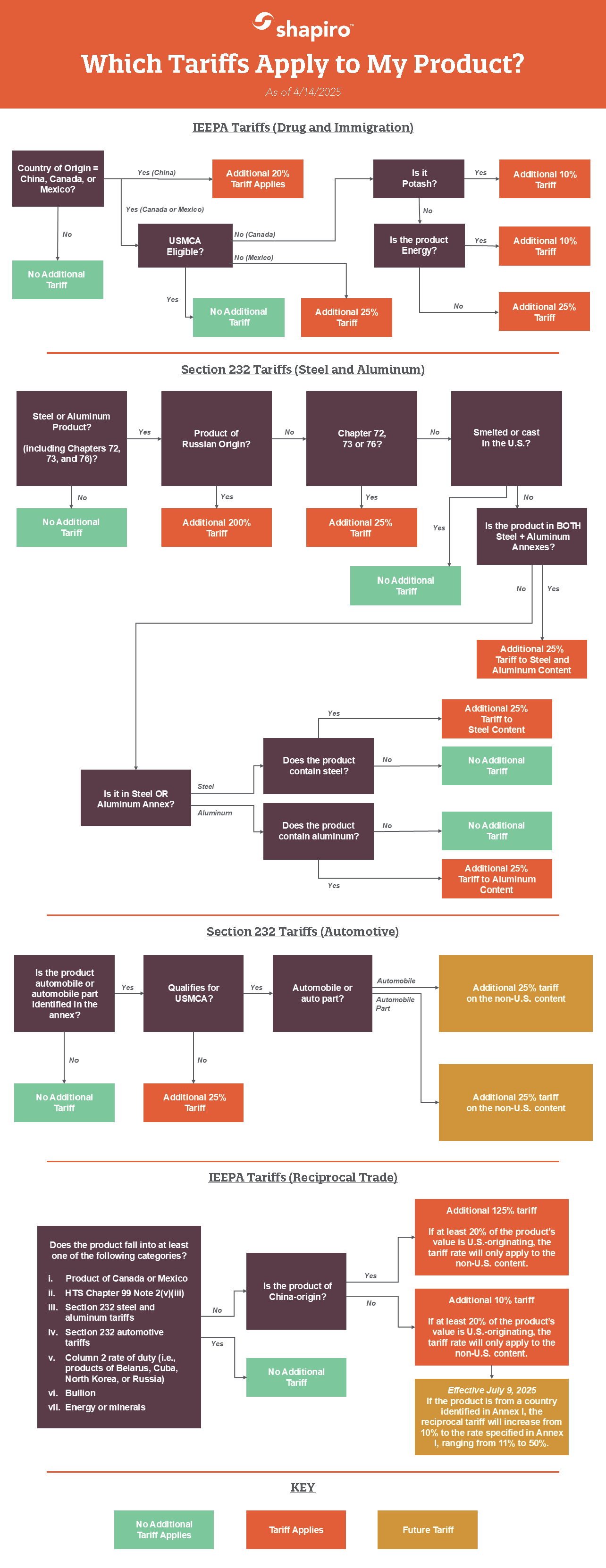
Frequently Asked Questions
Yes. The universal 10% tariff went into effect on April 5th. For any country listed in Annex I with a specified reciprocal tariff rate, the rate defined in Annex I will replace the universal 10% tariff for anything sailing on or after April 9th. For all other countries not listed in Annex I, other than Canada or Mexico, the universal 10% tariff will apply.
Please refer to Annex I
Yes! Exceptions include:
– Articles covered by national security exemptions under 50 U.S.C. 1702(b)
– Steel, aluminum, automobiles and parts are already subject to prior proclamations and existing tariff regimes; they will not be affected by the new tariffs.
– Specific products such as copper, semiconductors, pharmaceuticals, lumber, critical minerals, and energy goods (as detailed in Annex II)
– Goods subject to Column 2 rates of the HTSUS
– Items that may be targeted under future Section 232 actions
Yes it is. All duties are additive.
The sail date refers to the departure date of the vessel or aircraft that is ultimately destined to the United States, regardless of any transshipment along the way.
Free Trade Agreements still apply, but the universal 10% or reciprocal tariff will apply as well.
If goods are USMCA compliant then they can be imported duty free. If the goods are not USMCA compliant, or do not have an accompanying USMCA certificate, an additional rate of 25% will apply.
Items subject to Section 232 are excluded from this order, but Section 232 duty will apply if the article is subject.
Looking for Help with Tariffs?
Check out our Tariff Consulting Services to see how Shapiro can help you get ahead of the game and stay prepared for any upcoming tariffs!