Featured Headlines:
Masters of the Sea: Four Gods and a German
USTR Hits Snooze Twice More on 301
Testing, Testing…Is This Lab On?
EPA Pest Practices at the Port
Who's Paying for this Fire Sale?
Thanksgiving: All the Fixings, None of the Fixes
The United States of Imports
- America wants its factories back. We want American jobs, American products, and industrial independence. We also want inexpensive furniture, electronics, toys, and seventeen things we never knew existed until Amazon suggested them. Preferably delivered yesterday. Welcome to the United States of Imports.
- According to Descartes, U.S. maritime container imports reached a record 2.67 million TEUs in October, up 16% year-over-year and a whopping 29.2% above pre-pandemic October 2019. Tariffs, trade wars, geopolitical hostilities, and ambitious reshoring campaigns have complicated international commerce. They certainly haven’t frightened away the fully laden container ships.
- And then there’s China. Remember China? The country we’re supposed to be buying less from? Chinese-origin imports reached 987,805 TEUs, up 22.9% year-over-year. China supplied 36.9% of October’s maritime container volume and nearly half the monthly increase. If this is economic decoupling, somebody forgot to tell China we’re breaking up. Apparently, we’re still accepting a million containers of anniversary gifts.
- What’s inside those Chinese containers? Plastics, furniture, machinery, toys, and sporting goods. Chinese toy and sporting goods shipments alone jumped 32.5% year-over-year. Evidently, Santa’s workshop still has an extensive Asian supplier network. America talks about a domestic diet, then sneaks downstairs at midnight to gorge on Chinese takeout.
- But let’s not bury American manufacturing just yet. More imports don’t necessarily mean fewer American factories. Those factories need foreign machinery, components, and raw materials, too. A product proudly assembled in Ohio might contain parts from six countries and enough international paperwork to qualify for a passport. Turns out, even Made in America has a foreign accent.
- And these figures don’t tell the whole story. Descartes measures maritime container imports, excluding the enormous truck and rail trade with Canada and Mexico. Include those cross-border shipments, and America’s international commercial entanglements become even more impressive. Our continental neighbors are enormous trading partners, even if their merchandise prefers eighteen wheels to forty-foot containers.
- Nor does one spectacular month prove an economic revolution. Year-to-date container imports are up a modest 2.3%. Still, four consecutive months above 2.5 million TEUs have kept the world’s factories busy. Meanwhile, average transit delays at ten major U.S. ports have climbed from 4.2 days in June to 6.3 in October. Apparently, globalization can deliver almost anything except punctuality.
- Has reshoring failed? Hardly. Is globalization invincible? Ask anyone paying tariffs or rerouting cargo around a war zone. But decades of specialized manufacturing, interconnected suppliers, and consumer expectations cannot be dismantled by political ambition alone. America may sincerely want to make more of what it buys. Until then, our industrial aspirations and shopping habits will continue their rather spectacular disagreement.
- Made in America is the ambition. Made everywhere is still the shopping list.
Masters of the Sea: Four Gods and a German
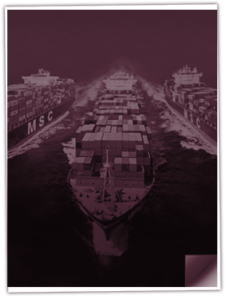
- High atop Mount Olympus, the four container shipping gods are preparing for battle. MSC, CMA CGM, Maersk, and Cosco are building enormous fleets, sharpening their competitive weapons, and eyeing one another’s market share. Zeus himself has apparently ordered yet another 24,000-TEU methanol-powered vessel.
- Shipping analyst (and god) Lars Jensen sees a fundamental shake-up by the 2030s. The Big Four are accumulating enough capacity to operate increasingly independent global networks, reducing their reliance on alliances. MSC has already demonstrated the concept. The others are quickly assembling their thunderbolts.
- Unfortunately, the gods have a mathematical problem. Their enormous order books will arrive in a market already threatened by overcapacity. Mount Olympus is running out of worshippers, but the gods keep building bigger temples. Expect aggressive action, shifting partnerships, and bruising freight-rate competition.
- Down the mountain, fifth-ranked Hapag-Lloyd has its own divine ambitions. Its proposed $4.2 billion acquisition of Zim would protect its Top Five standing, but even their combined fleets and orderbooks total just 3.8 million TEUs, compared with Cosco’s 5.6 million. That’s a considerable climb to Olympus for a mere mortal!
- Hapag also has a more immediate problem: not enough ships. Third-quarter volumes slipped 0.5% despite a growing global market, with the carrier blaming limited vessel availability. Curiously, quarterly profit still reached $1 billion. Apparently, scarcity is rather profitable when you’re selling all of it.
- Enter Zim, the $4.2 billion answer to Hapag’s capacity prayers. Hapag CEO Rolf Habben Jansen remains confident, but Israel wants additional assurances about wartime shipping access and national security. The revised deal still requires government and competition approvals, pushing the anticipated closing into early 2027. After all, even aspiring gods must bow before regulators.
- Meanwhile, Evergreen, ONE, HMM, and the other ambitious mortals aren’t surrendering. More consolidation could eventually produce six giant independent networks instead of today’s four major east-west networks. More competition among fewer companies? Only in container shipping does that qualify as perfectly reasonable arithmetic, noble readers.
- For shippers, the coming years should bring more carrier choices, shifting alliances, and a glorious buyer’s market. The gods may command the oceans, but the mortals still control the cargo by golly.
- And if the gods keep building ships nobody needs, Mount Olympus may soon resemble the ruins of ancient Greece.
USTR Hits Snooze Twice More on 301
- The Office of the U.S. Trade Representative (USTR) has pushed back two Section 301 deadlines involving China and Vietnam. Apparently, even trade policy occasionally needs five more minutes.
- First up: China. USTR has extended the suspension of Section 301 port fees on Chinese-linked vessels, along with additional duties on Chinese ship-to-shore cranes and other cargo-handling equipment.
- The pause was scheduled to expire November 9, but will now remain in place through 11:59 p.m. ET on January 9, 2027. No port fees or added equipment duties are owed while the suspension continues.
- This extension is considerably shorter than the original one-year pause, giving Washington and Beijing another two months to negotiate without putting the entire issue back into long-term storage.
- January 10 remains the date circled in red. USTR could extend the suspension again, modify the measures or allow the fees and duties to take effect. Public comments also urged the agency to separate the crane duties from the vessel fees, so the two measures may not remain calendar buddies forever.
- USTR also gave itself more time to complete its Section 301 investigation into Vietnam’s protection and enforcement of intellectual property rights. The investigation opened May 29, and the decision deadline has moved three months to February 28, 2027.
- No tariffs or other trade actions involving Vietnamese goods have been announced. For now, this is a postponed decision, not a surprise duty bill waiting behind the curtain.
- Importers using Chinese-linked vessels or purchasing Chinese cargo-handling equipment should prepare for the possibility that the pause ends in January. Companies sourcing from Vietnam should also map affected products and suppliers before February, because a delayed alarm still has every intention of ringing.
- For additional details, please refer to the official Federal Register Notices:
Testing, Testing…Is This Lab On?
- The Federal Communications Commission (FCC) has given the electronics industry a two-year mic check. Beginning December 1, 2028, where certain devices are tested will matter almost as much as whether they pass.
- Under FCC 26-73, equipment-authorization applications received on or after that date must rely on certification testing performed by an FCC-recognized laboratory located in the United States or a reciprocal economy.
- The rule applies to radiofrequency devices that require FCC certification before they can be imported or marketed in the United States. Products using the Supplier’s Declaration of Conformity process are not covered by this particular requirement. The FCC adjusted the soundboard, but it did not crank every dial at once.
- The FCC currently lists 62 reciprocal economies, including Canada, Mexico, Japan, South Korea, Taiwan, Hong Kong, Singapore, the United Kingdom and EU member states. Mainland China is conspicuously absent from the playlist.
- The Commission is also closing the geographic equivalent of lip-syncing. A laboratory cannot keep an eligible address in one country while conducting the substantive testing and technical review somewhere the FCC does not recognize. The paperwork and the people doing the work must finally sing the same tune.
- Similar location restrictions apply to telecommunications certification bodies and laboratory-accreditation bodies, largely placing existing FCC practice into the official rulebook. Consider that the less glamorous regulatory remix.
- The FCC is not pulling the plug on work already in progress. Existing equipment certifications remain valid, and applications received before December 1, 2028 may proceed under the prior rules. Properly authorized products will not require retesting solely because the original laboratory later loses FCC recognition.
- Manufacturers and importers should identify which laboratories support their FCC certifications, determine whether those facilities will remain eligible and begin qualifying alternatives where necessary. Companies relying on testing in mainland China have two years to move the microphone before the FCC cuts the feed.
- December 2028 may sound comfortably distant. Product-development calendars have a funny way of making two years disappear faster than a wireless signal behind a concrete wall.
EPA Pest Practices at the Port
- The Environmental Protection Agency (EPA) has been increasing its import-enforcement presence at air, land and seaports across the country. It turns out the agency’s pest-control strategy now includes inspecting the shipments themselves.
- Working alongside U.S. Customs and Border Protection (CBP), the EPA has conducted targeted inspection efforts at locations including Los Angeles/Long Beach, Savannah, New York/Newark, Houston and the Pembina, North Dakota land port.
- The effort reaches beyond conventional pesticides. The EPA is targeting illegal pesticides and chemicals, along with products regulated under the Clean Air Act, Toxic Substances Control Act, Safe Drinking Water Act and other environmental statutes. That is a fairly large regulatory net, and EPA officials appears interested in seeing what wriggles.
- Some products entering that net may not look particularly pesticidal. Under the Federal Insecticide, Fungicide, and Rodenticide Act (FIFRA), certain ultraviolet-light systems, air purifiers, water filters, ozone generators and ultrasonic products may qualify as pesticidal devices when they claim to kill, repel, trap or otherwise control pests or microorganisms.
- The marketing language matters. An ordinary light is still a light; a light advertised as killing bacteria, viruses or other pests may have just volunteered for EPA oversight.
- Pesticidal devices generally do not require the same EPA product registration as pesticides. They must, however, be produced in an EPA-registered establishment, bear the proper establishment number and comply with federal labeling and production requirements. “Not registered” and “not regulated” are very different creatures.
- Importers must also satisfy the applicable Notice of Arrival requirements. Products that arrive with missing, inaccurate or noncompliant information can be detained or refused entry, which is one way for an air purifier to make the atmosphere noticeably worse.
- Companies importing pesticides, chemicals or products making antimicrobial or pest-control claims should review their labels, manufacturing-establishment information and entry procedures before EPA and CBP do it for them.
- Additional guidance is available through EPA’s Pesticide Registration Manual for Devices and its import requirements for pesticides and devices. The inspections may be increasing, but the best defense remains wonderfully boring: know what the product claims, know which rules follow and make sure the paperwork does, too.
Who's Paying for this Fire Sale?
- A container ship catches fire in the South Atlantic. Its 28 crew members abandon ship. Most of its cargo may be destroyed. And somewhere in the wreckage of this maritime nightmare, an accountant is preparing to split the bill. Welcome to the peculiar world of general average.
- The nearly 12,000-TEU Espirito Santo Express, owned by Seaspan and chartered by Hapag-Lloyd, caught fire October 15 while sailing from Singapore to Santos, Brazil. All 28 seafarers were rescued by the bulk carrier Aeolian Arrow, but the rescue turned tragic when the rescuing vessel’s chief officer fell overboard and was lost at sea.
- What started the inferno? Seaspan reports that smoke and flames were first observed coming from cargo forward of the ship’s accommodation block. The ignition source remains unknown. Investigators will undoubtedly scrutinize the possibility of hazardous or improperly declared cargo, a persistent concern aboard container ships. For now, the culprit remains unidentified.
- After weeks of firefighting, the blaze has reportedly been extinguished and the vessel is now under tow, although its destination remains undisclosed. Hapag-Lloyd has warned that the vast majority of the cargo is probably severely damaged or a total loss.
- Now comes the financial insult to maritime injury. The shipowners have declared general average, meaning extraordinary sacrifices and qualifying expenses incurred to save the maritime venture will be shared proportionately among the interests that benefited. Think of a restaurant where somebody orders lobster, sets the tablecloth on fire, and everyone gets a bill for the fire extinguishers.
- General average dates back more than 2,000 years, long before Blackbeard, Long John Silver, or even marine insurance. Ancient Mediterranean sailors sometimes threw cargo overboard to save a sinking ship. Rather than bankrupt the unlucky merchant whose goods went swimming, everyone whose property survived shared the loss. A remarkably civilized arrangement for an era when pirates were considerably less civilized.
- Cargo interests will reportedly need to provide both general-average and salvage security before any recovered merchandise is released. Cargo insurance can cover insured losses and, subject to policy terms, qualifying salvage and general-average contributions. Without appropriate coverage, an importer could discover that losing the merchandise was only the first expensive surprise.
- The final accounting could take years. Meanwhile, cargo owners may face damaged inventory, disrupted deliveries, salvage claims, and a paperwork marathon. The lesson? When your container goes up in smoke, you really don’t want your insurance coverage to disappear with it.
Thanksgiving: All the Fixings, None of the Fixes
- Thanksgiving dinner is still almost two weeks away, but the ports of Los Angeles and Long Beach are already arguing over the seating arrangements. The Pacific Maritime Association and ILWU Local 26 have extended their contract deadline to November 20, their third postponement since a threatened November 1 strike.
- Don’t let the small guest list fool you. Local 26 represents roughly 250 security watchmen working at six terminals handling more than half the complex’s cargo, including approximately 85% of Long Beach’s volume. That’s a mighty small group with its hands on a very large turkey.
- Meanwhile, the Federal Maritime Commission has reopened the family’s favorite argument: who pays when the container sits too long? Researchers are being asked to examine detention and demurrage charges, distinguish avoidable from unavoidable delays, and determine whether the people paying the bill are actually responsible for the mess. Pass the gravy….and the blame.
- Over at CSX, somebody unplugged the oven. A technology outage lasting nearly 36 hours disrupted electronic billing, terminal gates, and intermodal communications. Systems were recovering by Thursday, with reservation requirements temporarily suspended and intermittent glitches still possible. Apparently, even railroads can suffer a Thanksgiving kitchen catastrophe.
- Trucking companies have another reason to loosen their belts. Driver recruitment costs jumped 41% year-over-year in Q3, while 46% of carriers surveyed raised driver pay over the preceding 90 days. Compensation remains drivers’ biggest concern, and somebody eventually must pick up that tab.
- For shippers, the holiday menu includes potential West Coast labor disruptions, disputed accessorial charges, intermodal headaches, and higher trucking expenses. Keep alternative routings handy, document questionable fees, …annnnd prepare for the inevitable Thanksgiving tradition: too much on your plate, too many complaints, and nobody willing to clean up the mess!